What happens to nonprofit giving when the donation page dissolves into the conversation
- Design
- Research
- Presentation
The nonprofit sector does not adopt new technology when it is proven; it adopts new technology when mass consumer behavior makes non-adoption untenable. Amazon, not fundraising conferences, legitimized online giving. Gmail, not vendor whitepapers, dissolved cloud objections. The iPhone forced mobile-first donation experiences. Across eight technology waves since 2000, the same pattern has repeated: consumer expectations change first, and the nonprofit sector follows.
The space between those two moments is the Adoption Lag.
“I’ve lived through 25 years of technology shift in the nonprofit sector and here is what I think it means for AI adoption.”
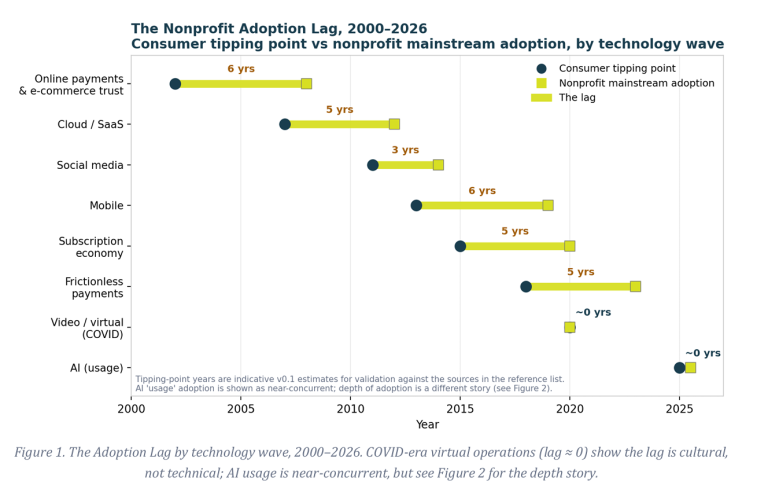
The nonprofit sector’s relationship with new technology follows a repeating, measurable cycle. Across online payments, cloud, social, mobile, subscriptions, and frictionless payments, nonprofit adoption trailed consumer tipping points by roughly three to six years. The objections were nearly identical each time: security, readiness, mission distraction, cost, and loss of control.
COVID provides the clearest proof that the lag was cultural, not technological. When waiting was no longer an option, the sector moved events, workplaces, and program delivery online in weeks. The lag went to zero.
AI is different. ChatGPT reached an estimated 100 million users in two months, compared with nine months for TikTok and 2.5 years for Instagram. By early 2026, roughly half of U.S. adults were using AI chatbots and 60% were reading AI-generated search summaries.
On the surface, the Adoption Lag has finally closed: sector usage tracks consumer usage in real time, exactly as the shrinking-lag trend predicted. But the same benchmark contains the wave’s defining statistic: of the 92% using AI, only 7% report major improvement in what their organization can accomplish. 65% describe their use as reactive and individual, and 79% report gains that are real but incremental. The lag has not closed; it has moved inside the organization. This wave shows a gap between sector usage and sector transformation.
The evidence suggests the nonprofit sector will not get its customary grace period this time. Organizations budgeting for a 2030 AI decision are, on the historical pattern, making a 2027 decision without knowing it.
The forecast is not about whether nonprofits will use AI. Surface-level usage is already approaching saturation. The question is how quickly organizations move from individual efficiency to embedded experience and then to intelligence. The trust ladder points to a sequence: efficiency first, experience second, intelligence last.
The eighth conversation about AI is happening now, and it differs from the others in one respect: the waiting room has been removed. Staff adopted before the sector could deliberate, and donors are adopting faster than staff.
The data supports a posture that is neither breathless nor cautious but sequenced: industrialize the efficiency rung now, govern it with policy, and instrument the donor-facing rung as consumer normalization dissolves the authenticity objection. Organizations that internalize the pattern will do something this sector has never done in twenty-five years: adopt on the consumer curve, and bank the years the lag used to cost. History names the price of waiting: it is measured in the decade-long mobile conversion tax the sector is still paying today.
Dowload and read the full report
Download the full paper
11 pages
Download the presentation slide
11 pages
Want to read more like this?
Be the first to know about new features, fundraising tips, and what’s next for Escalator.